
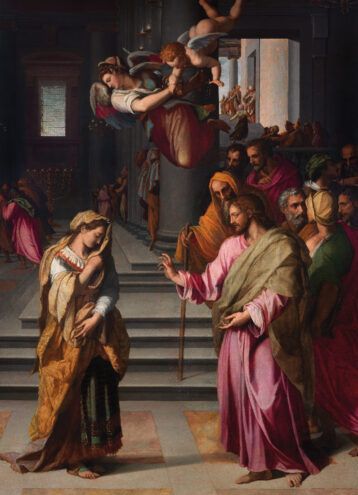
Christ and the Adulteress
1577
The painting by Alessandro Allori, created in 1577 for the Cini Chapel in the Basilica of Santo Spirito, depicts the Gospel episode of Christ and the Adulteress (John 8:1–11), one of the most intense and human moments in the Gospel of John. The painter interprets the famous passage in which Jesus, confronted with a woman caught in adultery, utters words destined to mark Christian conscience forever:
“Let him who is without sin among you be the first to throw a stone at her.”
Allori translates this teaching of mercy into visual form through a composition of great balance, in which every element is charged with theological and symbolic meaning. Christ, at the center of the scene, is portrayed with a solemn expression, while before Him the adulteress appears humble and penitent, yet at the same time dressed in sumptuous garments, a sign of refined elegance. Her green dress, the precious fabrics, and the pearl necklace—the most costly jewel of the time—are details that reveal a precise moral intention: in the Florence of Cosimo I de’ Medici, sumptuary laws imposed strict rules on clothing, and only court ladies or prostitutes were permitted to wear such attire. Allori therefore identifies the adulteress as a figure of lust, yet illuminates her with Christ’s forgiveness, offering the viewer a message of redemption and salvation.
In the background, the artist introduces the setting of the Temple, with an architectural structure that opens the perspective and accommodates the group of scribes and Pharisees. Above, two celestial figures appear: an angel and a cherub, one holding a sword, the other a set of scales—attributes of Divine Justice. Heaven itself breaks into the scene to seal Jesus’ act as one of perfect justice, superior to earthly judgment.
The altarpiece was commissioned by Giovan Battista Cini, a cultured man, literary figure, and playwright, and a prominent member of the court of Cosimo I and Francesco I de’ Medici. Cini, author of biographies, theatrical works, and the program for the magnificent wedding celebrations of Francesco I and Joanna of Austria (1565), was a close friend of Allori, and it was precisely this bond that led to the creation of the work. In the predella, the painter portrays the patron together with his family: Giovan Battista Cini in red attire, his wife Alessandra Altoviti, their daughters, and a priest, with their country villa, Le Rose, near Tavarnuzze, in the background. The predella thus becomes both a family portrait and a declaration of faith and spiritual belonging.
The work was created in the full climate of the Counter-Reformation, only a few years after the conclusion of the Council of Trent (1563). In this period, sacred art moved away from the dramatization of sin and hell to favor images of mercy, redemption, and salvation. The Christ of the Counter-Reformation is no longer a suffering or dying Christ, but a living, powerful, and redeeming Christ, capable of instilling hope in the faithful. Allori, following these principles and drawing inspiration from Michelangelo, depicts a strong and radiant Christ, a symbol of the new post-Tridentine spirituality.
Over the centuries, the chapel passed from the Cini family to the Dainelli d’Abbagnano, who replaced the original coats of arms with their own, represented by a deer, still visible today on the upper frame and on the paliotto. Despite these changes, the painting has preserved intact its spiritual power and historical value: it is at once an artistic testimony, a political document, and a theological reflection, capable of uniting the Gospel message with the cultural and ideological context of Medicean Florence.
As historian Giovanni Cipriani has noted, Christ and the Adulteress is not merely the representation of a sacred episode, but a true mirror of 1577, a visual manifesto of the Counter-Reformation, of divine justice and human mercy, filtered through the intelligence and sensitivity of Alessandro Allori.