
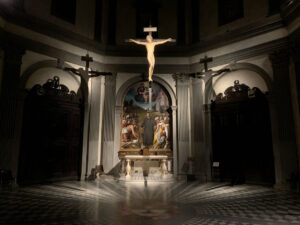
Visit the Basilica and the Augustinian Path and the Young Michelangelo

Visiting the Basilica of Santo Spirito means entering a unified monumental complex, where architecture, art, and spiritual life still coexist today in a rare balance.
The visit unfolds as a continuous and coherent path, guiding the visitor from the vast space of the Brunelleschian church to the more intimate environments of the Augustinian complex. These are not separate experiences, but a single itinerary, designed to be experienced gradually, allowing architecture, light, and artworks to guide both the gaze and the movement.
The experience includes two complementary levels: on the one hand, the Basilica, the liturgical and architectural heart of the complex, freely accessible; on the other, an itinerary granting access to historical spaces usually closed to the public, offering a more intimate and contemplative reading of Santo Spirito.
The visit is not conceived as a simple tourist experience, but as a moment of slow passage, in respect of the nature of the place, prayer, and the daily life of the religious community.

The Basilica of Santo Spirito
The visit follows the nave, chapels, and high altar in a continuous dialogue between architecture, art, and spirituality.
The Augustinian Museum Path
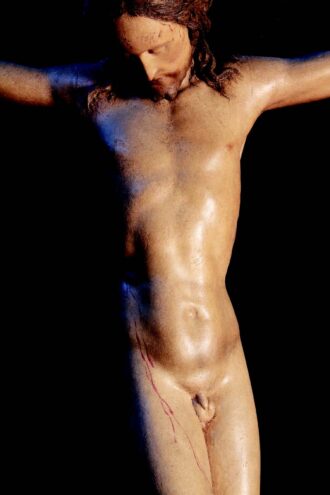
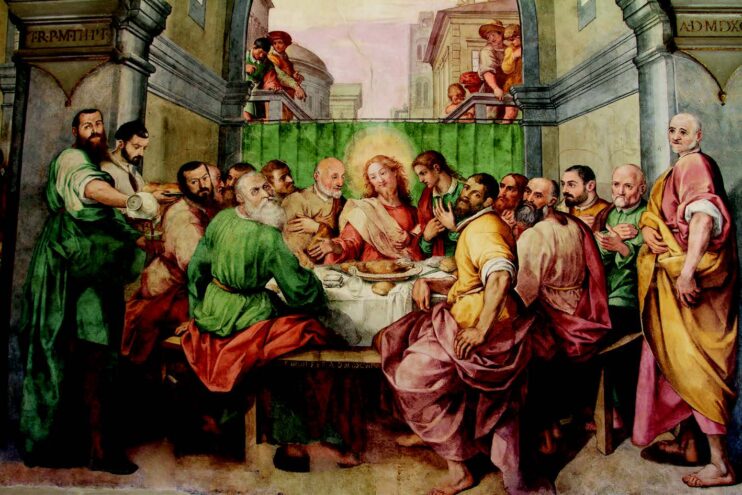
An intimate and evocative itinerary leading from the vestibule to the Sacristy, where Michelangelo’s wooden Crucifix is preserved, and onward to the Cloister of the Dead, the Chapter House, and the Refectory with the celebrated frescoes by Poccetti.
Opening Hours and Access
Check the opening hours of the Basilica, liturgical celebrations, and the museum path.
All the information you need to plan your visit respectfully.
The Basilica – Interior Path
The entrance to the Basilica of Santo Spirito introduces the visitor to a space conceived as a living and everyday place of worship, where Brunelleschian architecture engages in dialogue with centuries of Florentine art. The interior path unfolds along the naves and side chapels, following an itinerary that connects architectural space, artworks, and the liturgical function of the church.
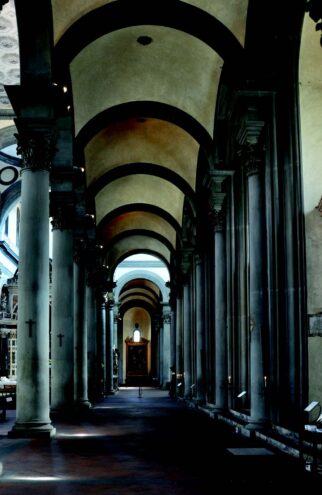
The visit begins along the right nave, following the natural flow of the architecture designed by Filippo Brunelleschi. From the very first steps, the visitor is immersed in a harmonious space, where the regular rhythm of the bays, the proportion of the forms, and the diffused light guide the gaze in a journey of knowledge and interior reflection.
Along the side aisles unfolds a dense sequence of chapels, entrusted over the centuries to the great Florentine families, who played a decisive role in the religious, artistic, and civic life of the Basilica. Paintings, marble decorations, sculptures, and stained glass interact with Brunelleschi’s architecture without ever disrupting its balance, creating a continuous narrative that unites faith, art, and civic memory.
Continuing into the right transept, the path opens onto chapels of particular significance, including those associated with the Nerli, Frescobaldi, Cini, and Dainelli da Bagnano families, testifying to the deep relationship between the Basilica and the social fabric of the Oltrarno. Here, private devotion intertwines with great Renaissance and Mannerist painting, offering the visitor a layered reading of the sacred space.
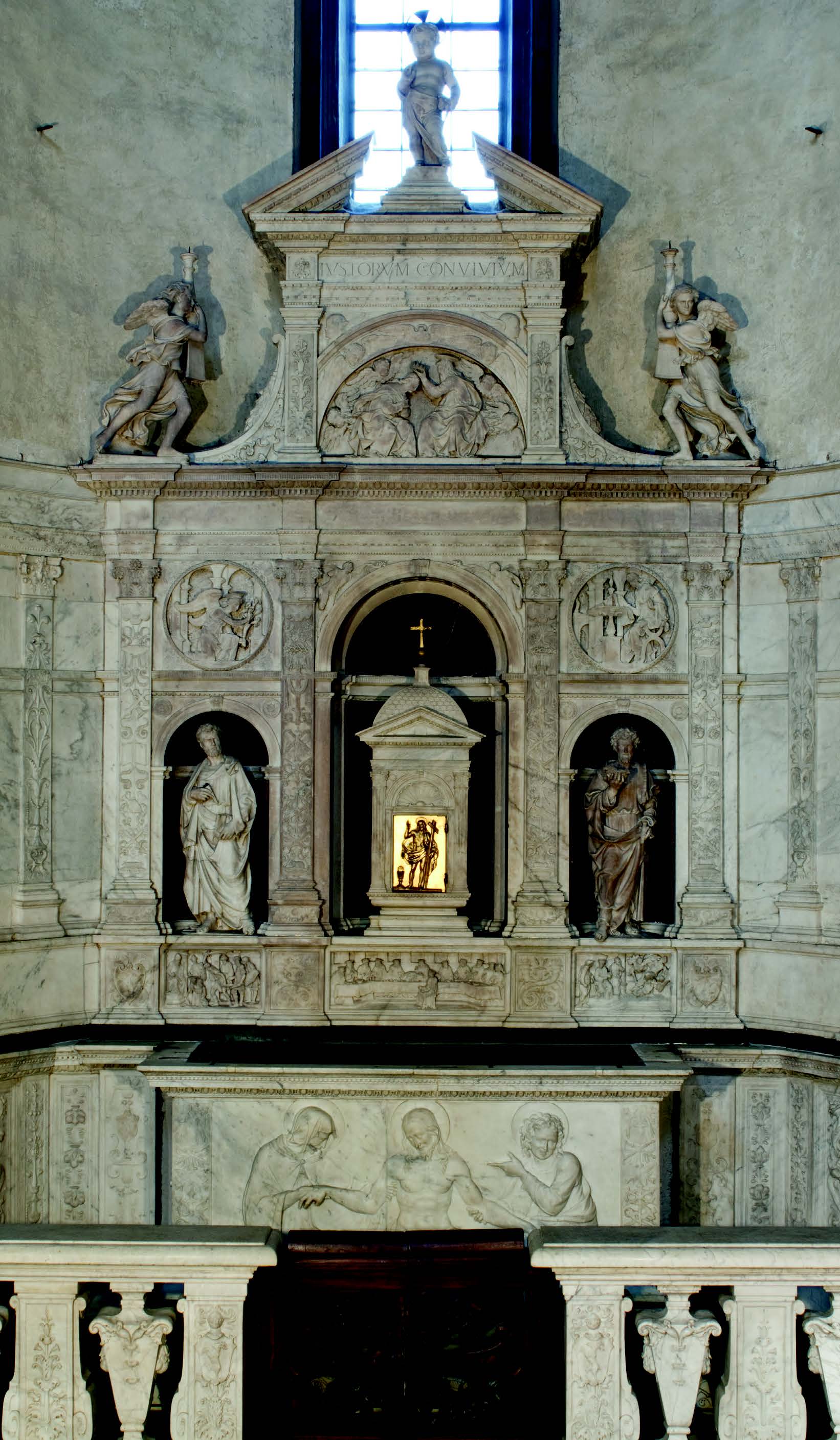
One of the masterpieces of the Florentine Renaissance in the Basilica of Santo Spirito, an example of perfect balance between architecture and sculpture.
Approaching the crossing, attention is naturally drawn to the monumental balance of the whole and to the Corbinelli Chapel, a masterpiece by Andrea Sansovino, where architecture and sculpture achieve a synthesis of extraordinary elegance, recalling classical models reinterpreted in a Renaissance key.
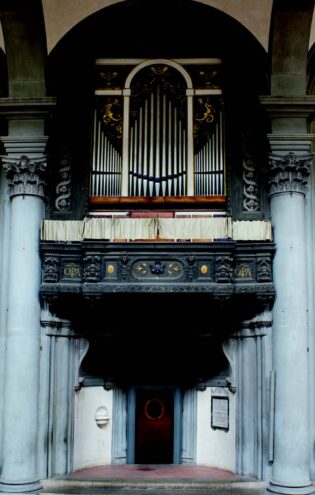
Above the entrance to the vestibule stands the historic organ, which symbolically introduces the Augustinian museum path. From here, access is gained to the vestibule and the sacristy, the spiritual and artistic heart of the complex, designed by Giuliano da Sangallo. At the center of the sacristy is preserved the celebrated wooden Crucifix by Michelangelo, a youthful work of intense expressive power, representing one of the highest moments of the visit. The museum path also leads to the Cloister of the Dead, the Chapter House, and the Refectory, enriched by frescoes by Poccetti, expanding the understanding of Augustinian convent life.
Returning to the Basilica, the path continues along the left nave, where further chapels and works by artists such as Ridolfo and Michele del Ghirlandaio, Taddeo Landini, and Pier Francesco Foschi complete the circular journey within the sacred space.
The journey culminates at the High Altar, an imposing 17th-century structure that occupies the liturgical center of the Basilica. Built between the late 16th and early 17th centuries to a design by Giovan Battista Caccini, with the collaboration of Gherardo Silvani and Agostino Bugiardini known as Ubaldini, the altar represents one of the most significant moments in the architectural and devotional history of Santo Spirito.
Its position, at the intersection of the naves, makes it the symbolic and spiritual focal point of the church, where space and liturgy converge.
→ dedicated insight on the High Altar
The side chapels, distributed along the entire perimeter of the church, constitute an artistic and devotional heritage of extraordinary richness. Each of them is the subject of a specific in-depth section, illustrating its history, patronage, and artworks, allowing visitors to continue their exploration with a more attentive and informed perspective.
The Augustinian Museum Path
The entrance to the Augustinian museum path is located beneath the organ, inside the Basilica.
This itinerary leads the visitor through spaces of particular spiritual and historical intensity, offering a more intimate reading of the monumental complex.
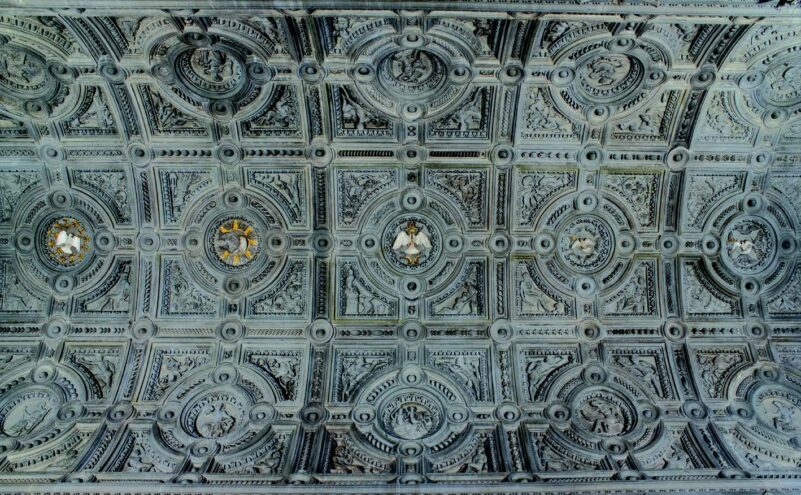
The path begins in the vestibule, enriched by a coffered ceiling created by Andrea Sansovino in 1491, and leads to the Sacristy, designed by Giuliano da Sangallo.
The octagonal plan, the measured alternation of pietra serena and plaster, and the controlled light create a space of essentiality and silence.
At the center of the Sacristy stands one of the most intense works of the entire complex: the wooden Crucifix by the young Michelangelo Buonarroti.
Placed as the ideal axis of the space, the body of Christ—fragile yet solemn—establishes a silent and profound dialogue with the visitor, transforming the Sacristy into a place of contemplation and reflection.
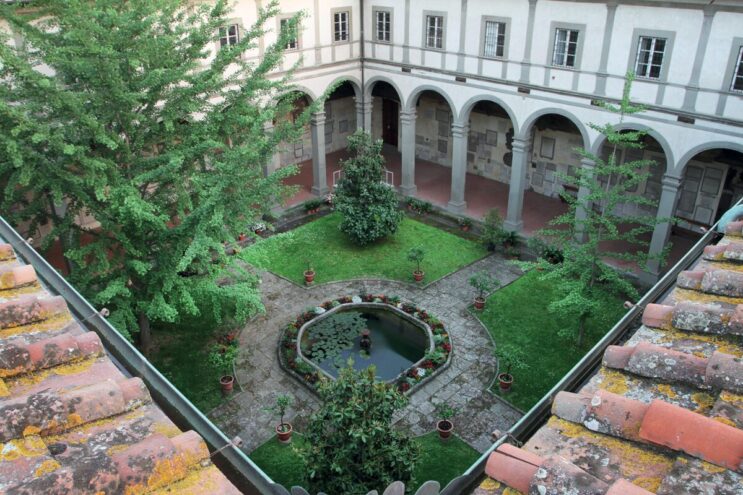
The museum path also includes the Cloister of the Dead, a place of recollection and memory, and the Refectory, which preserves the fresco of the Three Suppers by Bernardino Poccetti, an extraordinary testimony of convent life.
Access to the Basilica and the Museum Path
Access to the Basilica
Free admission
By decision of the Augustinian Community of Florence, the Basilica is always freely accessible, except during liturgical celebrations, which take priority over visits.
Opening hours
Monday to Saturday
10:00 – 13:00
15:00 – 18:00
(closed on Wednesdays)
Sundays and holidays
11:30 – 13:30
15:00 – 18:00
Museum path
Individual contribution: €2.00
The contribution supports the conservation, enhancement, and public access of the monumental spaces.
No reservation is required.
Tickets are not available online.
No external platform is authorized to sell them.
For agencies and groups
Although booking is not required, for agencies, organized groups, and collective visits advance notice is appreciated. Please send an email to info@basilicasantospirito.it.
If preferred, it is possible to pay the total entrance fee in advance via bank transfer to the account in the name of the Association A Minimo Incipe:
IBAN: IT08C0307502200CC8500910346
For individual visitors and small groups, no reservation is required.
Rules and Silence
The Basilica of Santo Spirito is прежде of all a place of worship.
Visitors are therefore kindly asked to maintain respectful behavior, characterized by silence and discretion, especially during liturgical celebrations.
- Appropriate clothing is required.
- Please do not disturb religious services.
- Photography is not permitted.
- Tour guides are required to use audio systems.