
The Augustinians in Florence:
eight centuries of faith, culture, and humanism in the Oltrarno
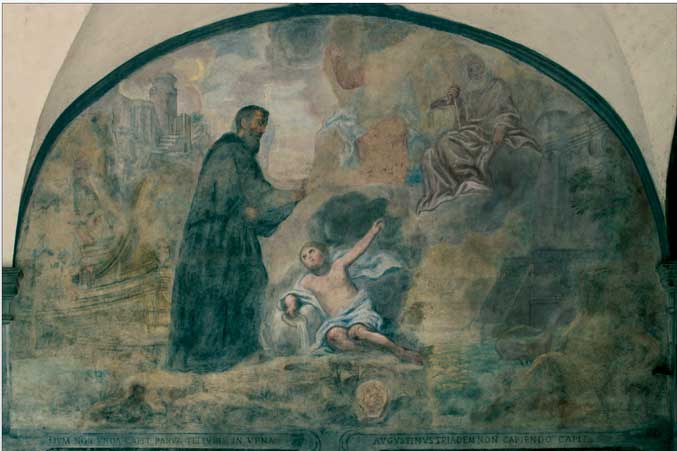
The presence of the Augustinians in Florence dates back to the early decades of the 13th century. In 1233, a group of hermit friars settled in Arcetri, in the area known as Lepore, where they founded a small hermitage dedicated to Saint Matthew, at the initiative of Pope Innocent IV. It was a mendicant and urban order, deeply engaged in preaching and in the life of the city.
In 1250, Spinello Accolti and Omodeo di Guido sold to Friar Aldobrandino, prior of the convent of San Matteo, a house, land, and vineyards in the area of today’s Santo Spirito district, then known as Casellina or Cuculia: a still rural and quiet area.
The Augustinians built an oratory and a small convent there, which soon became a religious and cultural point of reference for the Oltrarno. The first church, dedicated to the Virgin Mary, the Holy Spirit, and All Saints, dates back to 1252. In 1269, construction began on a new, larger and more solemn building, which would become the future Basilica of Santo Spirito.
A center of faith, art, and culture
As early as 1284, the Florentine convent was recognized as a Studium Generale of the Order, one of the most prestigious centers of theological and philosophical studies in Europe. A few years later, in 1287, it hosted an important General Chapter of the Augustinian Order.
With the expansion of 1292, the convent and the new Piazza Santo Spirito became an integral part of Florence’s urban, social, and intellectual life. The convent library, which by 1450 contained as many as 577 manuscripts, was considered one of the richest and most frequented in the city.
The Augustinians and Humanism
The convent of Santo Spirito became a crossroads of spirituality and humanistic culture. Friar Dionigi of Borgo San Sepolcro, teacher of Petrarch, taught here and gifted him a copy of the Confessions of Saint Augustine, profoundly influencing his thought.
The same community included Friar Luigi Marsili, a learned friar and humanist, who corresponded with Petrarch and Coluccio Salutati. His teaching helped make Santo Spirito a place of dialogue between faith and culture.
Giovanni Boccaccio also frequented the convent, forming a friendship with Friar Martino da Signa and leaving his personal library to the Augustinians.
Between the late 14th and 15th centuries, Friar Marsili’s cell became a meeting place for humanists such as Leonardo Bruni, Poggio Bracciolini, Niccolò Niccoli, Roberto de’ Rossi, and Giannozzo Manetti. One of the earliest literary academies of the Florentine Renaissance was born there.
Renaissance renewal
On 28 August 1397, the feast day of Saint Augustine, the construction of a new great church for the community was approved. Work began in 1434 and was later entrusted to Filippo Brunelleschi, who conceived its celebrated Renaissance design.
The Basilica of Santo Spirito thus became not only a place of worship, but also a symbol of Augustinian spirituality and of the intertwining of faith, art, and humanistic thought that characterized Florence during its most fertile period.
The Augustinians today
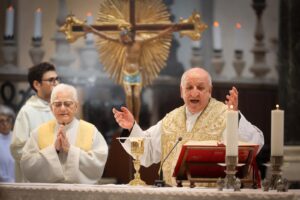
Today, the Basilica of Santo Spirito is entrusted to the Italian Province of the Order of Saint Augustine through the Augustinian Community of Florence. The General Curia of the Order is located in Rome, where the Provincial Council also resides, upon which the Florentine community depends.
The Augustinians continue to live in the heart of the city according to the teaching of their founder: uniting prayer and study, faith and culture, spirituality and civic life. As in past centuries, the convent of Santo Spirito remains a living place of welcome and dialogue, open to the search for truth and to the sharing of the values of Saint Augustine.