
A masterpiece of the Florentine Renaissance
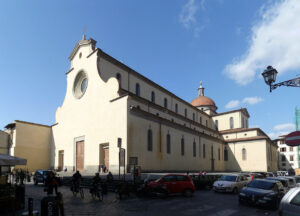
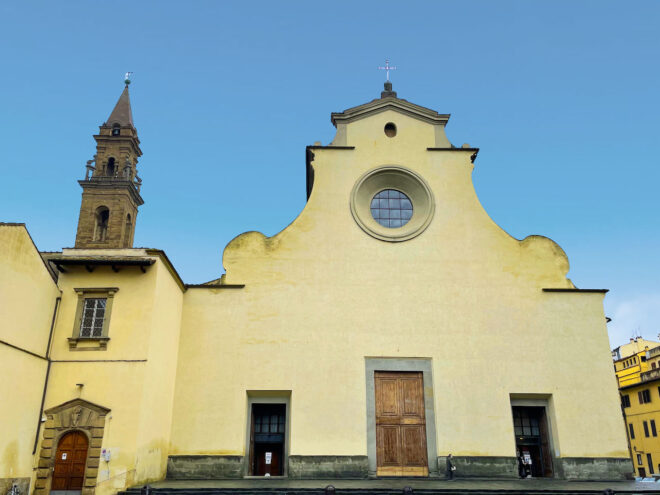
The Basilica of Santo Spirito is one of the most evocative and representative places in Florence. It stands on the left bank of the Arno, in the heart of the Oltrarno district, and is one of the greatest masterpieces of Renaissance architecture, designed by Filippo Brunelleschi in the central decades of the fifteenth century. Begun in 1434 and consecrated in 1481, the Basilica represents the most mature and radical outcome of his architectural vision.
From its earliest origins, the Basilica has been entrusted to the Friars of the Order of Saint Augustine, who still today safeguard its spiritual, cultural, and community life. Santo Spirito is not merely a monumental building, but a living place, deeply intertwined with the civic, artistic, and religious history of Florence, where architecture, art, and community life continue to engage in daily dialogue.
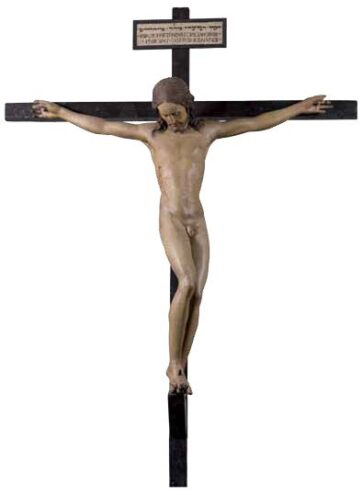
Inside, works of extraordinary artistic value are preserved, created by some of the leading protagonists of Florentine art. Among them stands out the wooden Crucifix by the young Michelangelo Buonarroti, one of the most intense and moving testimonies of his early artistic formation, closely linked to the Augustinian community of Santo Spirito.
From its earliest origins, the Basilica has been entrusted to the Augustinian friars, who still today safeguard its spiritual, cultural, and community life. Santo Spirito is not merely a monumental building, but a living place, deeply intertwined with the civic, artistic, and religious history of Florence.
Santo Spirito is not merely a monumental building, but a living place, deeply intertwined with the civic, artistic, and religious history of Florence, where architecture, art, and community life continue to engage in daily dialogue.
Within the Basilica are preserved works of extraordinary artistic value, created by some of the leading figures of Florentine art. Among them stands out a testimony of exceptional intensity and emotional power from Michelangelo’s early formation, closely connected to the Augustinian community of Santo Spirito.
History
The presence of the Augustinians in Florence dates back to the early decades of the thirteenth century. In 1233, some hermit friars initially settled in Arcetri, in the area known as Lepore, where they founded a small hermitage. A few years later, in 1250, the community moved to the area then known as Casellina or Cuculia, in today’s Oltrarno, purchasing land and building a first oratory and a small convent.
The first church, dedicated to the Virgin Mary, the Holy Spirit, and All Saints, dates back to 1252. In 1269, construction began on a larger and more solemn building, intended to become the spiritual and cultural center of the neighborhood. As early as 1284, the Florentine convent was recognized as a Studium Generale of the Augustinian Order, establishing itself as one of the main European centers of theological and philosophical studies.
During the fourteenth and fifteenth centuries, Santo Spirito became a true crossroads of Florentine humanism. Prominent figures such as Friar Dionigi da Borgo San Sepolcro, teacher of Francesco Petrarch, Friar Luigi Marsili, in dialogue with Coluccio Salutati, and numerous intellectuals associated with the emerging humanist movement taught and resided here. Giovanni Boccaccio also frequented the convent, leaving his personal library to the Augustinians.
In this climate of intense intellectual activity, the Library of the convent of Santo Spirito also developed, destined over the centuries to become one of the most important centers for the preservation and transmission of knowledge in the Florentine Oltrarno. From the fifteenth century onward, the Augustinian community collected and safeguarded manuscripts, theological texts, and literary works, making the Library an essential instrument for study, research, and dialogue between faith and culture. After a long process of reorganization and enhancement, the Library was reopened to the public in 2025 and is now dedicated to Father Stanislao Bellandi, who in the twentieth century promoted its renewal and modern organization with foresight.
The same vocation for cultural and philosophical dialogue characterizes the tradition of the Convegni di Santo Spirito, whose roots lie in the meetings promoted by Friar Luigi Marsili in the second half of the fourteenth century. In these gatherings, attended by leading figures of Florentine life—humanists, politicians, merchants, and scholars—issues of great intellectual relevance were discussed, contributing to making Florence one of the driving centers of European Humanism.
In the twentieth century, this tradition was consciously revived by Father Gino Ciolini, prior of the convent and distinguished scholar, who from the late 1970s established the modern Convegni di Santo Spirito, restoring to the Augustinian complex its role as a living place of reflection, study, and dialogue. The proceedings of the conferences were collected and published in a series issued by Augustinus / Città Nuova.
Within this profound intertwining of spiritual life, intellectual inquiry, and openness to the world lies the deepest meaning of the Basilica’s dedication to the Holy Spirit. This is not a merely formal dedication, but the expression of a precise theological and anthropological vision: the Spirit is the principle of understanding, discernment, and interiorization of faith, the one who makes Christ’s teachings alive and operative in human conscience. As emerges from Augustinian reflection, the Holy Spirit guides the path of both the community and the individual believer, enlightening the mind and orienting the heart. A historical and theological insight into this dedication is offered by the study of Professor Giovanni Cipriani, which reconstructs the origin and meaning of the title in light of documentary sources and the Augustinian spiritual tradition.
On August 28, 1397, the feast day of Saint Augustine, the construction of a new great church was decided. Work began in 1434 and was entrusted to Filippo Brunelleschi, who conceived one of his highest and most innovative projects. The Basilica of Santo Spirito thus became a symbol of the encounter between Augustinian spirituality, Renaissance architecture, and humanist thought, an intertwining that still defines its profound identity today.
Architecture
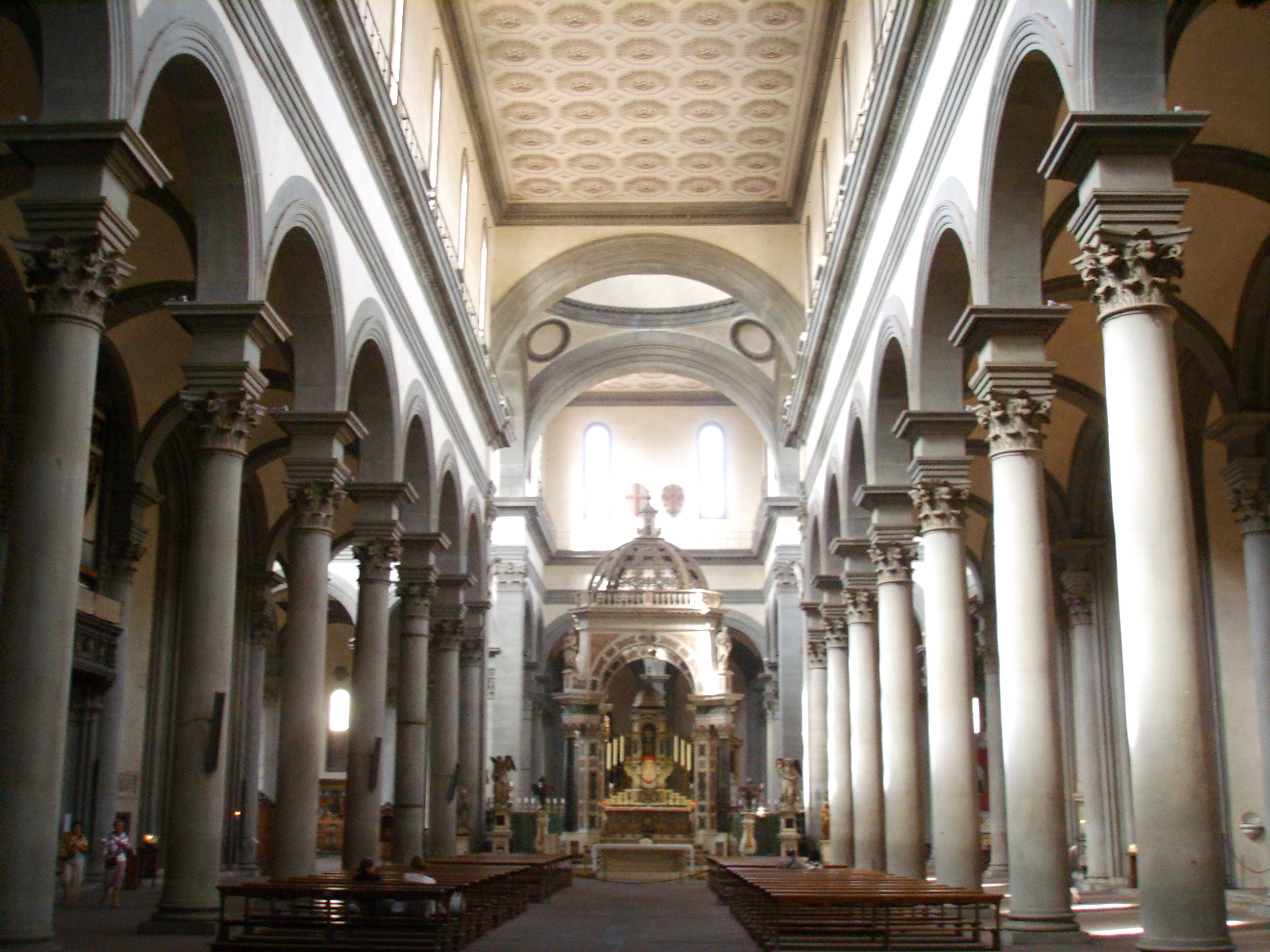
Crossing the threshold of the Basilica of Santo Spirito, the eye is immediately drawn to the perfect balance between structure and harmony, the distinctive hallmark of Brunelleschi’s architectural language. The space opens naturally, without spectacular effects, through a rigorous measure that silently guides the visitor.
The pietra serena columns, crowned with Corinthian capitals, rhythmically articulate the nave and support the sail vaults, creating a continuous dialogue between geometric order and sensory perception of space. The entire building is governed by a constant module, which defines the naves, chapels, and proportions, translating into architecture an idea of rational and harmonious order. The clarity of proportions, the linearity of the axes, and the visual expansion convey a profound sense of balance, peace, and freedom.
Brunelleschi does not impose a single reading of the building. Multiple perspectives and modular organization allow each visitor to choose their own path, to move freely, and to establish a personal relationship with the sacred space. Each visit thus becomes a unique experience, capable of engaging not only on an aesthetic level, but also on an interior and spiritual one.
The principal works preserved in the Basilica
The Basilica of Santo Spirito preserves an artistic heritage of extraordinary richness, the result of centuries of patronage and of the central role this place has played in the cultural history of Florence. The works constantly engage in dialogue with Brunelleschi’s architecture, integrating into the liturgical space without ever overpowering it, according to an equilibrium that privileges measure and overall harmony.
Of outstanding importance is the wooden Crucifix by the young Michelangelo Buonarroti (1493), created during the artist’s stay at the Augustinian convent. Characterized by intense naturalism and profound anatomical sensitivity, the work represents one of the most moving testimonies of Michelangelo’s early formation and of his relationship with the community of Santo Spirito.
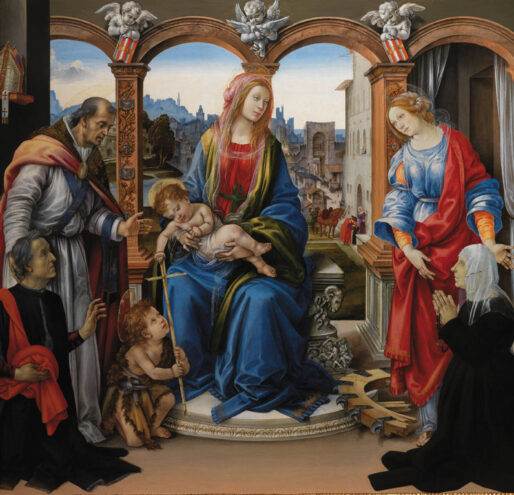
Within this same context stands the presence of Filippino Lippi, author of the celebrated Nerli Altarpiece (1485–1488), one of the highest expressions of late fifteenth-century Florentine painting. The work is distinguished by its iconographic complexity and by its ability to engage with Brunelleschi’s architectural order through a refined, intensely spiritual, and deeply human language.
Among the principal works preserved in the Basilica are also:
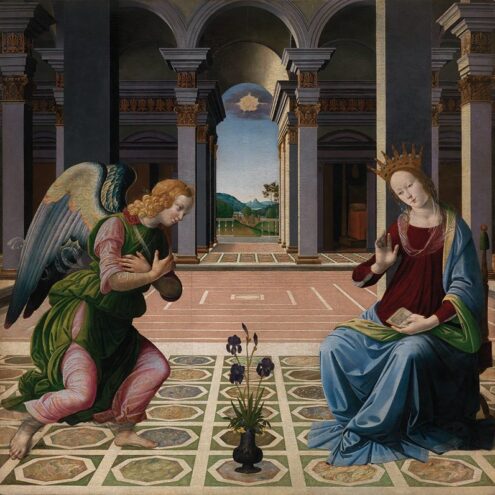
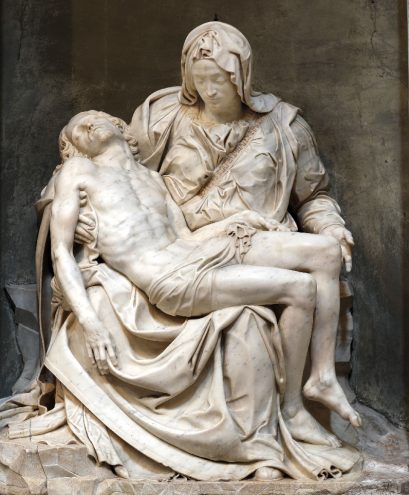
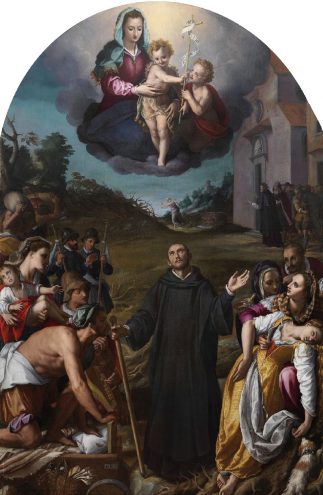
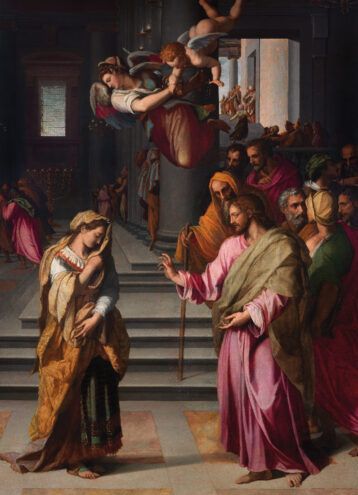
Alongside these masterpieces are works by artists such as Andrea Sansovino, Bernardino Poccetti, Pier Francesco Foschi, Michele and Ridolfo del Ghirlandaio, and many others. The result is a harmonious whole, in which art and architecture converge to create an environment of intense expressive power and profound spiritual contemplation.