
Michelangelo’s Crucifix
A Christ Born in the Silence of Santo Spirito
In the wooden Crucifix created by Michelangelo Buonarroti for Santo Spirito lies one of the most profound and silent moments of his early formation. A work born within the Augustinian convent, it still invites contemplation rather than mere observation.
Michelangelo’s Crucifix
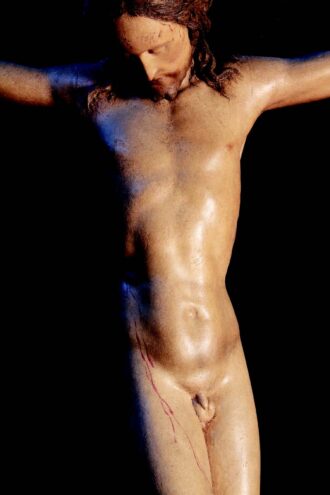
In Santo Spirito, the Crucifix by Michelangelo Buonarroti is not merely a work of art, but a tangible sign of a profound encounter between art, the human body, and Augustinian spirituality. Born within the convent, in the silence of a community devoted to study, prayer, and hospitality, this Christ was not conceived as an image to be displayed, but as a figure to be contemplated, to be prayed before, to be experienced inwardly.
Dated between 1492 and 1493, when Michelangelo was about eighteen years old, the Crucifix was created during his stay at the convent of Santo Spirito. Here, the young sculptor found not only hospitality, but also the opportunity—granted by the prior Nicolò Bichiellini—to access the convent hospital, where he could study human anatomy on the bodies of the deceased. This experience, recorded in historical sources and recalled by Giorgio Vasari and Ascanio Condivi, profoundly shaped his development, bringing together scientific knowledge, theological reflection, and communal life. The Crucifix was created as a gesture of gratitude toward the Augustinian community that had welcomed and supported the young artist at a crucial moment in his journey.
The Christ, described in the sources as «almost life-size», already reveals an extraordinary anatomical understanding. Yet what is most striking is not the display of technical skill, but the expressive choice: Michelangelo renounces dramatic emphasis in favor of a composed sorrow, portraying a fragile and deeply human body with restraint, respect, and silence. It is a work that fully reflects the Augustinian spiritual climate, in which the body is not spectacle, but a place of interiority, listening, and discernment.
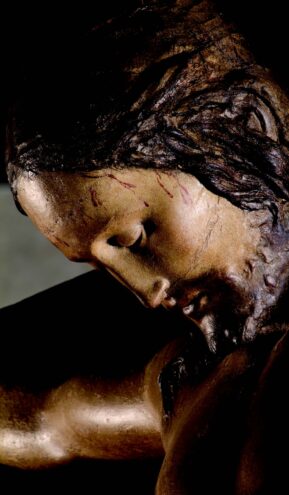
For centuries, however, the Crucifix remained in a state of concealment. Literary sources attested to its existence, but the work itself had been lost. It was only in 1962 that the scholar Margrit Lisner, while cataloguing Tuscan wooden crucifixes, identified in the convent refectory a sculpture of exceptional quality. Its refined carving and formal innovation led her to promote its restoration, which revealed beneath later repainting a work of extraordinary plastic quality.
On the basis of both documentary sources and stylistic evidence, Lisner recognized in that Crucifix the wooden Christ executed by Michelangelo for Santo Spirito. Thanks also to the support of the Augustinian community, and in particular Father Guido Balestri, it was possible to restore identity and visibility to a work that had long remained suspended between written memory and material absence.
In 1964, after restoration, the Crucifix was presented to the public as a youthful work by Michelangelo, first in Rome and then in Florence, sparking a wide critical debate. It was later placed in Casa Buonarroti, where it remained for several decades, becoming a key reference for the study of Michelangelo’s early production.
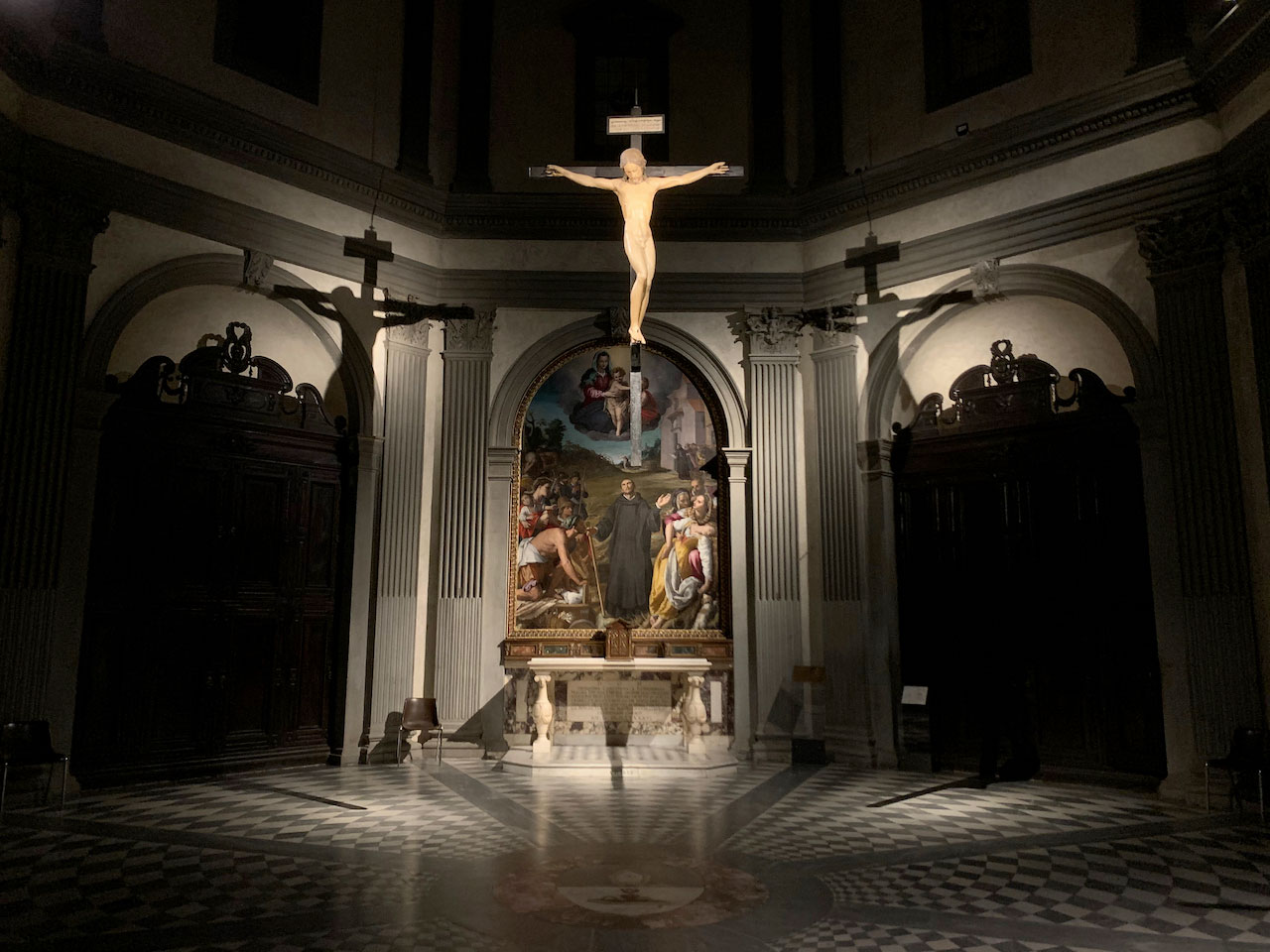
Only in 2000 did the Crucifix finally return to Santo Spirito. It was not possible to restore its original placement above the high altar, which had been altered in the 17th century with the construction of the altar by Giovan Battista Caccini; it was therefore placed in the Sacristy designed by Giuliano da Sangallo, an intimate and measured space perfectly suited to the nature of the work.
Today, Michelangelo’s Crucifix represents the spiritual and symbolic heart of the visitor’s journey. Not only an extraordinary testimony to the artist’s early formation, but also the sign of a profound relationship between art, study, and faith. A work born in the silence of a convent, rediscovered after centuries, and returned to its original home as a place of contemplation, where knowledge and spirituality continue to engage in an intimate and essential dialogue.