
Works and Artistic Heritage of the Basilica of Santo Spirito
Art, Space, and Spirituality
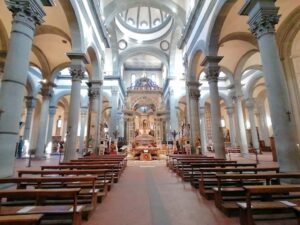
The Basilica of Santo Spirito preserves an extraordinarily rich artistic heritage, developed over the centuries in constant dialogue with the architecture and the spiritual life of the Augustinian complex. The works are never conceived as autonomous or celebratory elements, but as parts of a unified whole, in which painting and sculpture are integrated into the rhythm of the naves, chapels, and light, contributing to an experience grounded in measure, harmony, and interiority.
Nerli Altarpiece
1485–1488
The Basilica of Santo Spirito preserves a vast and stratified artistic heritage, developed over the centuries in constant dialogue with the religious, cultural, and civic life of the city. The works are never conceived as isolated elements, but as parts of a unified fabric, in which painting, sculpture, and architecture together define a space of deep expressive and spiritual coherence.
In this context, art does not serve a celebratory or decorative function. Images accompany the journey through the sacred space, following the rhythm of the naves, chapels, and light, and contribute to shaping an atmosphere in which beauty is always subordinate to the sense of space and the spiritual dimension. The visitor’s experience is not centered on a single masterpiece, but on a progressive immersion, in which each work enters into dialogue with the others and with Brunelleschi’s architecture.
Among the earliest and most significant works is the polyptych by Maso di Banco (1341–1346), preserved in the Vettori Chapel. Transferred to the new church in 1480, it represents the only surviving painted panel from the original medieval complex. A follower and collaborator of Giotto, Maso di Banco depicts the Madonna and Child flanked by Mary Magdalene, Saint Andrew, Saint Julian, and Saint Catherine of Alexandria, according to a scheme typical of early 14th-century Florence.
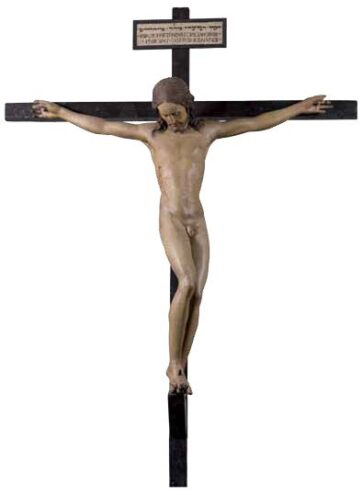
Among the masterpieces of the Renaissance stands the wooden Crucifix by Michelangelo Buonarroti (1493), created during the artist’s stay at the Augustinian convent. The intense naturalism of the figure and the profound anatomical attention already reveal the extraordinary expressive power of the young Michelangelo, as well as the deep connection between the study of the human body, spiritual reflection, and communal life that shaped his formation at Santo Spirito.
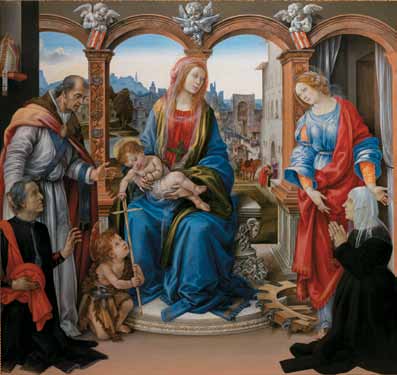
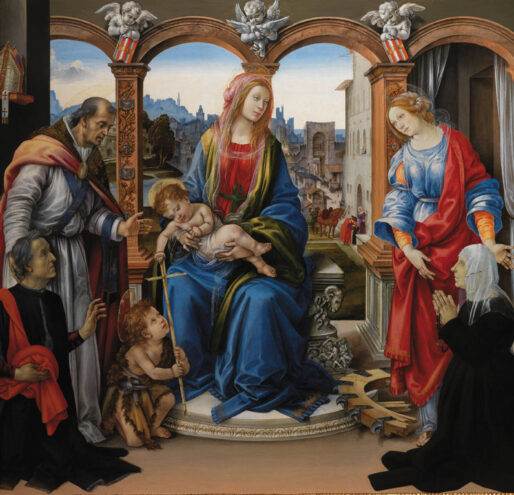
Belonging to the same cultural climate is the Nerli Altarpiece by Filippino Lippi (1485–1488), one of the highest achievements of late 15th-century Florentine painting. The work is distinguished by its iconographic complexity and its ability to integrate into Brunelleschi’s space without disturbing its balance, through a refined, measured, and deeply human pictorial language.
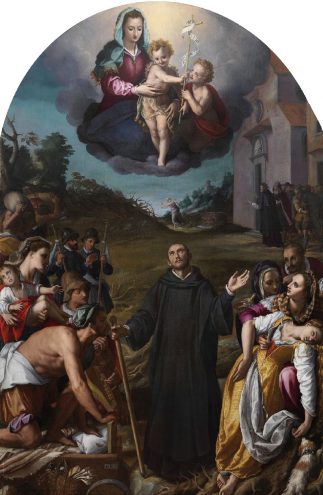
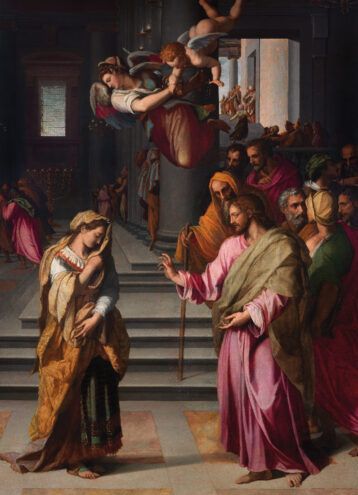
Alongside these masterpieces, the Basilica preserves a rich ensemble of works testifying to the continuity of its artistic and spiritual history. Among them are works by Pietro del Donzello, Nanni di Baccio Bigio, Alessandro Allori, as well as Andrea Sansovino, Bernardino Poccetti, Pier Francesco Foschi, Michele del Ghirlandaio and Ridolfo del Ghirlandaio, among many others.
The result is a coherent and harmonious whole, in which art is never an end in itself, but an integral part of a path designed to accompany prayer, meditation, and the experience of sacred space. A heritage that, in its variety, remains faithful to the measure and balance that define the most authentic identity of Santo Spirito.
Main Works in the Basilica
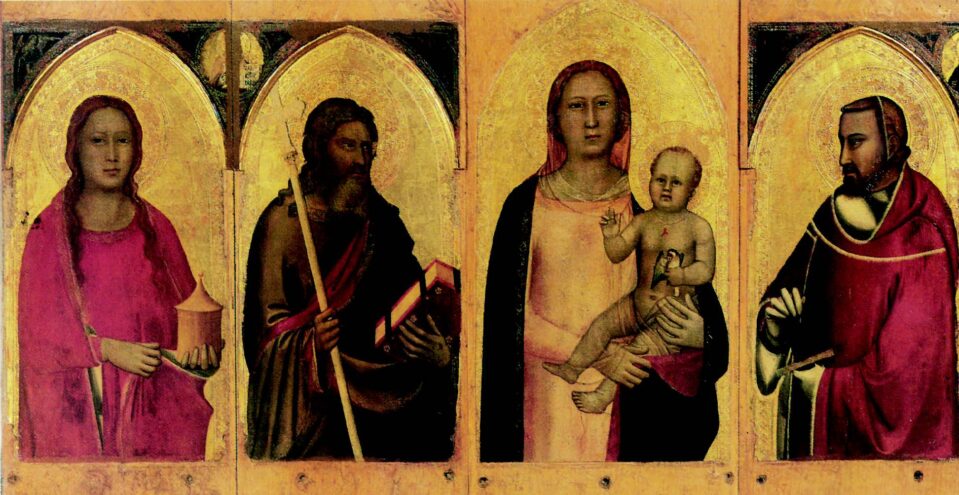
Il polittico di Maso di Banco (1341 – 1346)