History of the Basilica of Santo Spirito
A Place Shaped by Time
The history of Santo Spirito unfolds over the long term, where religious life, intellectual inquiry, and the relationship with the city have been continuously intertwined.
From its Augustinian origins to the Renaissance, the complex has accompanied the cultural and spiritual growth of the Oltrarno, becoming one of the most significant places of humanistic Florence.
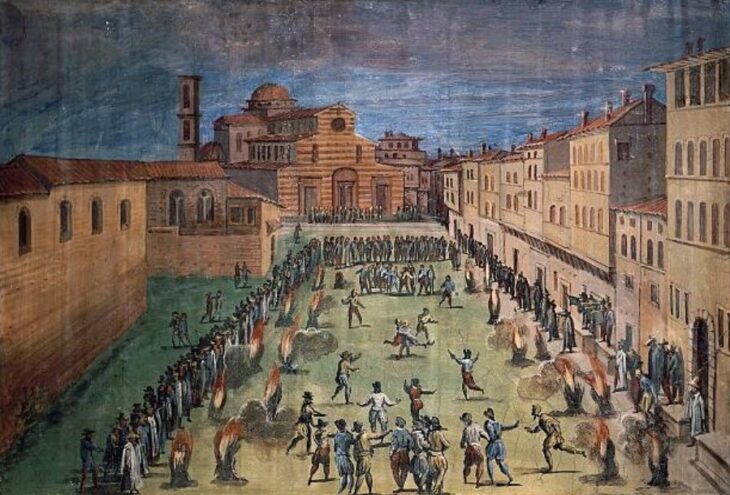
Santo Spirito Between Religious Life, Culture, and the City
The presence of the Augustinians in Florence dates back to the early decades of the 13th century. In 1233, a group of hermit friars initially settled in Arcetri, in the area known as Lepore, where they founded a small hermitage. A few years later, in 1250, the community moved to what is now known as the Oltrarno, then called Casellina or Cuculia, acquiring land and building a first oratory and a small convent. From the very beginning, the Augustinians became a point of reference not only religious but also cultural and social for the local population, establishing a deep and lasting relationship with the Florentine urban fabric.
The first church, dedicated to the Virgin Mary, the Holy Spirit, and All Saints, dates to 1252. In 1269, construction began on a larger and more solemn building, destined to become the spiritual and cultural center of the area. As early as 1284, the Florentine convent was recognized as a Studium Generale of the Augustinian Order, establishing itself as one of the main European centers for theological and philosophical studies and consolidating Santo Spirito’s role as a place of learning and intellectual development.
During the 14th and 15th centuries, Santo Spirito became a true crossroads of Florentine Humanism. Prominent figures such as Fra Dionigi da Borgo San Sepolcro, teacher of Francesco Petrarch, and Fra Luigi Marsili, who maintained a fruitful dialogue with Coluccio Salutati, taught or stayed here. Giovanni Boccaccio also frequented the convent, leaving his personal library to the Augustinians. In this context, Santo Spirito emerged as a meeting place for religious reflection, intellectual inquiry, and civic life, contributing decisively to the development of Florentine humanistic culture.
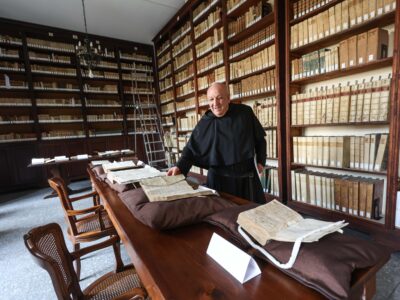
Within this vibrant intellectual environment, the Library of the Convent of Santo Spirito also developed, destined over the centuries to become one of the most important centers for the preservation and transmission of knowledge in the Oltrarno. From the 15th century onward, the Augustinian community collected and safeguarded manuscripts, theological texts, and literary works, making the Library an essential instrument of study, research, and dialogue between faith and culture. After extensive reorganization and restoration, the Library was reopened to the public in 2025 and is now dedicated to Father Stanislao Bellandi, who in the 20th century promoted its revival and modern organization.
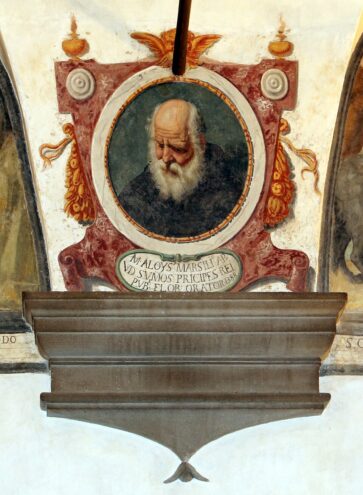
This same vocation for cultural and philosophical dialogue is reflected in the tradition of the Conferences of Santo Spirito, whose roots go back to the meetings promoted by Fra Luigi Marsili in the second half of the 14th century. These gatherings, attended by humanists, politicians, merchants, and scholars, addressed topics of great intellectual relevance, contributing to making Florence one of the driving centers of European Humanism. In the 20th century, this tradition was revived by Father Gino Ciolini, who established the modern Conferences of Santo Spirito, restoring the Augustinian complex as a living place of reflection, study, and dialogue.
Within this deep interweaving of spiritual life, intellectual inquiry, and openness to the world lies the most authentic meaning of the Basilica’s dedication to the Holy Spirit. It is not a formal title, but the expression of a precise theological and anthropological vision: the Spirit as the principle of understanding, discernment, and interiorization of faith, the one who makes Christ’s teachings alive and active in human consciousness. As expressed in Augustinian thought, the Holy Spirit guides both the community and the individual, illuminating the mind and orienting the heart.
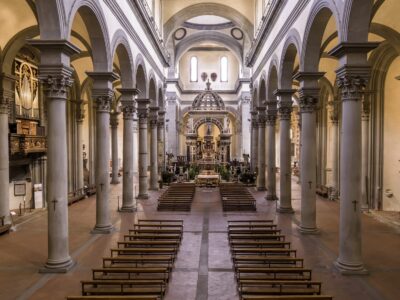
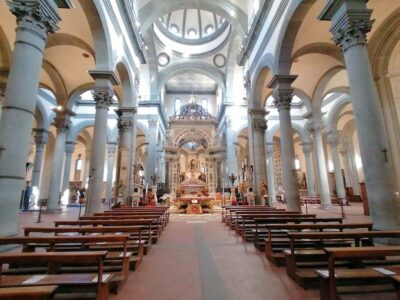
On August 28, 1397, the feast day of Saint Augustine, the community decided to build a new great church, intended to give architectural form to the spiritual and cultural centrality of Santo Spirito. Construction began in 1444 and was entrusted to :contentReference[oaicite:0]{index=0}, who here developed one of the most mature and coherent expressions of his reflection on sacred space. The architect’s death in 1446 prevented him from seeing its completion, but did not diminish the strength of his design.
The Basilica of Santo Spirito thus became a place where the Augustinian vision, Renaissance architecture, and humanistic thought are inseparably intertwined, giving rise to a profound balance between faith, reason, and measure that still defines its most authentic and enduring identity today.
Further Reading
Other paths for exploring and understanding the complex of Santo Spirito