Architecture of the Basilica of Santo Spirito
A space designed to be lived
The Basilica of Santo Spirito expresses a conception of sacred space founded on balance and continuity.
Brunelleschi’s architecture does not present itself as an object to be contemplated, but as a space to be experienced, in which proportion, light, and rhythm guide the experience without ever imposing themselves.
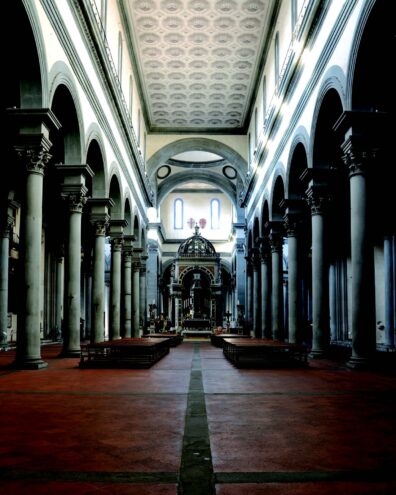
The Design of :contentReference[oaicite:0]{index=0}
The architecture of the Basilica of Santo Spirito represents one of the highest and most coherent expressions of Filippo Brunelleschi ’s reflection on sacred space. Here, the Renaissance architect brings to completion an idea of the church founded not on spectacle, but on measure, clarity, and the harmony of its parts.
Brunelleschi conceives a space that does not seek monumental effect, but a profound balance between structure, function, and perception. Architecture does not impose a single interpretation, but offers itself as a place to be inhabited, where spiritual and sensory experience proceed together.
Measure, Light, and Harmony of Space
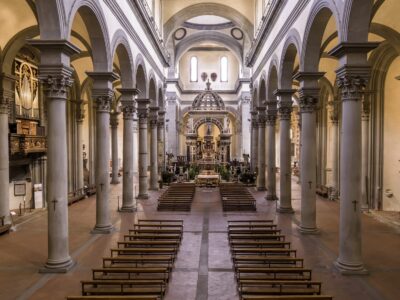
The layout is governed by a constant module, which regulates every element of the building: the naves, the chapels, and the overall proportions. The pietra serena columns, topped with Corinthian capitals, articulate the space with a regular rhythm and support the sail vaults, creating a structure that is clear and legible.
The light, diffused and never harsh, accompanies the gaze and helps create an atmosphere of calm continuity, in which nothing prevails and everything contributes to the unity of the whole. The geometric order is never rigid, but translates into visual and perceptual balance, encouraging a slow and conscious experience of the space.
The Plan and the Architectural Path
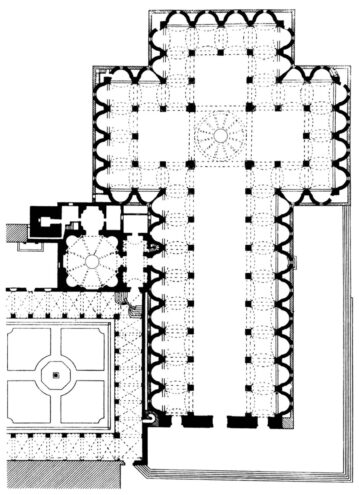
The plan of the church, apparently based on the traditional Latin cross layout, gradually reveals a deeper complexity. Moving along the central nave and through the side aisles toward the transept and choir, the visitor experiences a continuous variation of viewpoints, made possible by the fusion of the basilican scheme and a modular spatial conception.
The sequence of columns and niches generates an internal movement that invites one to move through the space, rather than observe it from a single privileged point. Brunelleschi does not impose a fixed path or a single interpretation of the building: the modular organization allows each visitor to establish a personal relationship with the sacred space, transforming the visit into an architectural, sensory, and interior experience.
The Exterior and Its Relationship with the Oltrarno
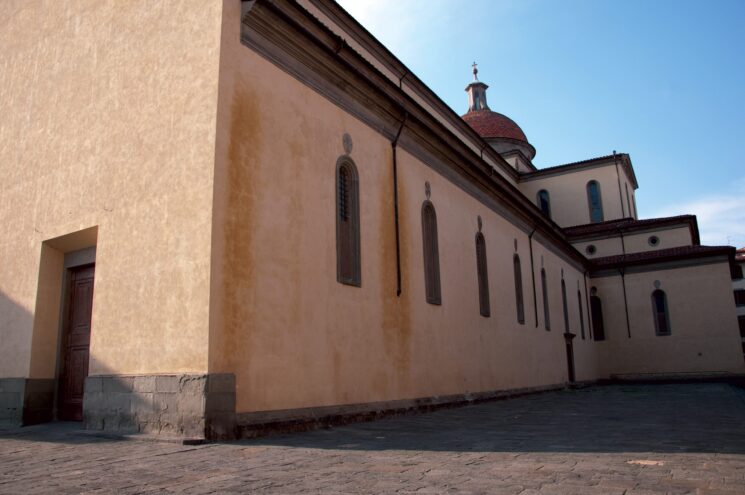
The exterior as well, deliberately restrained and devoid of monumental decoration, reflects this same conception. The plastered façade, completed in its current form at a later date, does not anticipate or display the richness of the interior space, but maintains a measured relationship with the square and the urban fabric of the Oltrarno.
It is an architecture that does not impose itself, but offers itself, integrating into the neighborhood with discretion and continuity. Its dialogue with the city does not rely on monumentality, but on spatial coherence and the capacity to welcome everyday life around it.
Architecture as a Spiritual Language
In Santo Spirito, architecture is never an end in itself.
It becomes a spiritual language, an instrument of order, silence, and concentration, consistent with the Augustinian vision that has inspired the life of the complex since its origins. The built space does not distract, but accompanies; it does not overwhelm, but guides, transforming architectural form into an invitation to measure and interiority.
Further Reading
Other paths for exploring and understanding the complex of Santo Spirito