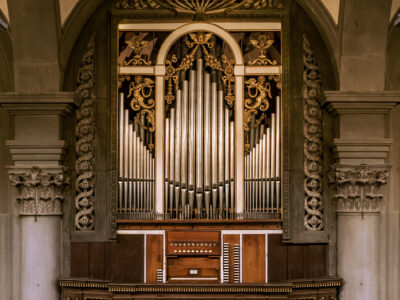
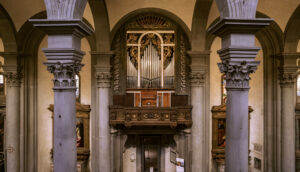
The recent restoration of the Tronci Organ and the choir loft of the Basilica of Santo Spirito represents an intervention of extraordinary importance for the preservation of Florence’s historical and artistic heritage, as well as for the liturgical life of the Augustinian community.
Carried out under the High Supervision of the Soprintendenza Archeologia, Belle Arti e Paesaggio, the project was made possible thanks to the support of Friends of Florence, through the generous contribution of Jim and Janet Dicke II.
The origins: “the cost was one thousand scudi”
Historical and art-historical research has made it possible to date with certainty the construction of the choir loft and the original organ to between 1551 and 1553.
As recorded in the so-called Libro nero of the Basilica’s Archive, the intervention had a total cost of one thousand scudi, excluding gilding.
The choir loft, made of walnut wood, is enriched with carvings of extraordinary quality:
female protomes, ram heads, and ornamental motifs testify to the work of highly skilled craftsmen, capable of achieving remarkable elegance and depth in wood.
From the Renaissance organ to the 19th-century Tronci instrument
The original organ, attributed to Fra Bernardo d’Argentina, underwent numerous interventions over the centuries.
In the 18th century, the Tronci family modernized it, but it was in 1824 that a new instrument was built, becoming the one we see today.
This monumental organ is characterized by:
- 68 keys
- 16-note pedalboard
- 38 stops
Its sound structure, based on the 16-foot Principal, together with stops imitating orchestral instruments (trumpets, horns, bassoon, clarinet, piccolo), makes it a true “miniature Romantic orchestra”.
The rediscovery of its original appearance
One of the most significant aspects of the restoration was the recovery of the choir loft’s original finish.
Over time, the entire structure had been covered with a grey overpainting, likely for liturgical reasons.
The removal of these layers revealed:
- the beauty of the walnut wood
- the original gilding
- the overall decorative balance
The restoration: technique and conservation
The intervention involved the entire complex, including:
- surface cleaning
- structural consolidation
- anti-woodworm treatment
- reintegration of missing elements
The gilding was recovered and reintegrated using traditional techniques, respecting the historical patina.
Particularly delicate was the restoration of the organ curtain, severely damaged by tears and deformation: thanks to a specialized intervention, it was possible to restore its original function.
A restoration that restores identity
This intervention represents not only a material recovery, but a true restoration of identity.
The organ and the choir loft return to being a living part of the Basilica, in their artistic, historical, and spiritual value, re-establishing the deep connection between architecture, music, and liturgy.
👉 The project was officially presented to the city on April 23, 2026:
read the article → “Santo Spirito finds its voice again”